 ultimate-guide
Facility Management Audit for Schools: Complete Guide
Quick Summary
A facility management audit for schools is a structured review of a school's buildings, systems, safety controls and operating processes, measured against a defined checklist. It shows leaders where their facilities stand today and what needs attention first.
- The audit covers building condition, mechanical and electrical systems, cleanliness, maintenance programmes and compliance documentation.
- A three-phase process runs from planning and governance through asset inventory and condition assessment to safety review.
- Each area is scored from 1 to 5 and weighted, with fire, electrical and water safety carrying double weight.
- Findings are assigned priority tiers, from P1 immediate action within 0-7 days to P4 monitoring.
- Every action needs an owner, deadline and closure test, and a second person should sign off completion.
Table of Contents
- What a Facility Management Audit for Schools Covers
- Why Schools Need Regular Facility Audits
- Facility Management Audit for Schools Checklist: Step-by-Step Process
- Facility Management Audit for Schools Template and Scoring Method
- School Facilities Maintenance Audit: Compliance, Documentation and Budget Priorities
- Facility Management Audit for Schools Sample Findings and Action Plan
- Booking Your School's First Facility Audit
- Frequently Asked Questions
What a Facility Management Audit for Schools Covers
A facility management audit for schools is a structured review of a school's buildings, systems, safety controls, and operating processes, measured against a defined checklist.
The audit reviews connected areas: building and infrastructure condition, mechanical and electrical systems, cleanliness and environmental quality, the maintenance program and open work orders, and documentation proving compliance with inspection and safety requirements.
Many schools treat these areas as separate tasks.
Why Schools Need Regular Facility Audits
Schools carry a heavy load of buildings, often built across decades, with changing enrolment, new technology, and tight budgets.
A recurring audit gives leaders a baseline. Once each building's condition is recorded, changes become visible, and spending can be tied to evidence rather than the loudest complaint, making capital planning easier to explain to boards and funders.
Regular audits also support compliance. Inspection schedules, safety records, and maintenance logs are easier to defend when reviewed on a set cycle, and gaps are caught before an external inspector finds them.
Facility Management Audit for Schools Checklist: Step-by-Step Process
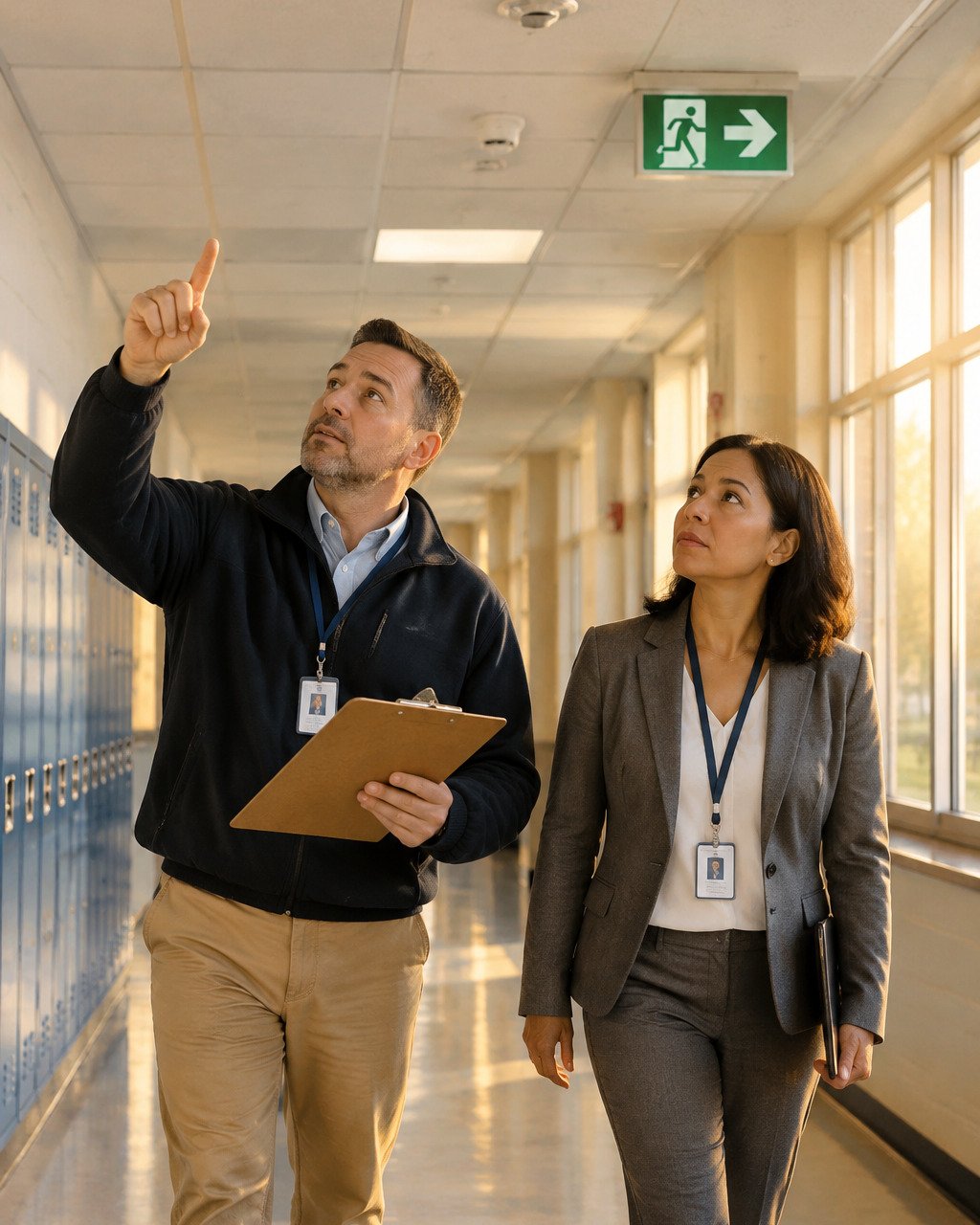
A practical audit runs in three phases. Each phase builds on the one before it, so it helps to finish planning before walking the buildings.
Phase 1: Planning, Roles and Stakeholder Governance
Start by deciding who owns the audit. A single accountable lead, usually the facilities director or business manager, should sign off the scope and timeline.
Define the scope in writing: which sites and buildings are included, which systems are covered, and what the audit will not examine.
Plan walkthroughs early. Give each building a visit window that does not clash with teaching time, and tell staff what to expect so the audit does not feel like an inspection of individuals.
Phase 2: Asset Inventory and Building Condition Assessment
Build an asset list for each building before inspecting it.
Then assess condition on a simple scale: good, fair, poor, and critical. A detailed facility condition assessment checklist can guide each building walkthrough.
Pay attention to the building envelope and interior finishes. Damp patches, cracked render, failing sealant, and worn flooring in circulation areas often signal problems that are cheaper to fix early.
Phase 3: Safety, Risk and Age-Appropriate Space Review
Walk the spaces with a safety lens. Check fire doors, escape routes, emergency lighting, signage, and the condition of fire-fighting equipment.
Age matters. A reception classroom, a secondary science lab, and a sixth-form common room present different risks.
Record each risk with a likelihood and severity rating. Assign a priority level so that urgent items are not buried in a long list.
Facility Management Audit for Schools Template and Scoring Method
A consistent scoring method turns observations into decisions. A common reason audits lose value is that findings are recorded in inconsistent formats that cannot be compared across buildings or budget cycles. The template below pairs every observation with a numeric score, a priority tier, and a named evidence source.
The scoring rubric
Score each audit area from 1 to 5 against a defined anchor, not a gut feeling. A workable five-point scale is:
- 5, Fully compliant and well maintained. No defects observed, records current, system within expected life.
- 4, Compliant with minor wear. Cosmetic or non-critical defects only, all records present.
- 3, Functional but deteriorating. Defects that will worsen within 12-24 months if unaddressed, or records partially incomplete.
Score each area on its own merits, then apply a weighting that reflects school priorities. A common pattern weights fire safety, electrical safety, and safeguarding-related spaces at double the weight of cosmetic fabric items, because a low score there carries legal and reputational exposure a worn floor does not.
The audit template
Each auditor completes one row per building per area. The columns below are the minimum; add a photo reference column if the CMMS supports attachments.
| Area | What to check | Score (1-5) | Weight | Weighted score | Evidence | Priority tier | Owner |
|---|---|---|---|---|---|---|---|
| Building fabric | Roof, walls, windows, doors, damp | 1 | Photos, notes | ||||
| Mechanical systems | Heating, ventilation, plant age, service history | 1 | Service records | ||||
| Electrical and lighting | Distribution boards, emergency lighting, PAT records | 2 | Test certificates | ||||
| Fire safety | Escape routes, fire doors, alarms, extinguisher servicing | 2 | Inspection logs | ||||
| Water safety | Legionella risk assessment, temperature checks, outlets | 2 | L8 records | ||||
| Asbestos | Register accuracy, condition of known ACMs, labelling | 2 | Survey, register | ||||
| Cleanliness and air quality | Cleaning regime, ventilation, damp, CO2 monitoring | 1 | Cleaning schedule | ||||
| Maintenance programme | Open work orders, response times, PPM completion rate | 1 | Work order report | ||||
| Documentation | Compliance records, asset register, filing location | 1 | Filing location | ||||
| Accessibility | Ramps, lifts, accessible toilets, signage | 1 | Photos, notes |
Weight
Multiply score by weight to get the weighted score, then sum the weighted scores for a building-level index comparable across a trust or district. A building scoring below 3.0 on any weighted area should be flagged for follow-up review within 30 days, regardless of its overall index.
Priority tiers
Score tells you how bad a finding is; priority tells you when to act. Use four tiers:
- P1, Immediate (0-7 days). Any score of 1, any statutory non-compliance, any hazard to occupants. Escalate to the headteacher and responsible body the same day.
- P2, Short term (1-3 months). Score of 2, or defects that will cause secondary damage if left. Schedule within the current term.
- P3, Planned (3-12 months). Score of 3, or lifecycle replacements that can be phased into the next budget cycle.
Watch out: a common failure is letting a P2 item drift into the next financial year because it is not visibly urgent; once a defect crosses into P1 territory it usually costs several times more to remediate and may force unplanned closure of a teaching space.
Benchmarking across buildings
Benchmark the weighted index, not the raw score, and benchmark like-for-like building types. A Victorian primary block and a 2010s secondary sports hall are not comparable on fabric condition, but they are comparable on fire safety, water safety, and documentation. Publish each building's index on a dashboard so governors see trend lines rather than a single snapshot. A single low score is a local problem; low scores across many sites on the same area point to a process, staffing, or budget issue.
Calibration
Before rolling the rubric out across a trust or district, run two auditors through the same building independently and compare scores. Where they diverge by more than one point, refine the anchor descriptions until they converge. This calibration makes the scores defensible when used to justify capital bids or challenge a contractor's performance.
School Facilities Maintenance Audit: Compliance, Documentation and Budget Priorities
Once walkthroughs are complete, findings need to connect to compliance records and money.
Documentation is often where audits succeed or fail. Each finding should point to a record: a service report, a certificate, a photograph, or a work order.
Budget priorities follow from the scores: safety-critical items first, then items protecting the building from further damage, then lifecycle replacements that can be phased.
Facility Management Audit for Schools Sample Findings and Action Plan
A sample finding shows how the template, scoring rubric, and priority tiers work in practice. The example below is a composite drawn from common patterns in secondary schools; specifics will differ, but the structure of the finding, action plan, and verification loop should not.
The finding
A secondary school's science block scores 2 out of 5 on fire safety (weighted score 4 out of 10). The auditor records three linked defects: a fire door on the main corridor has a failed closer and does not latch, the emergency lighting test log is three months out of date, and the most recent fire door inspection certificate is not on file. Each defect is photographed and cross-referenced to the relevant inspection schedule.
The action plan
Each action needs an owner, a deadline, a cost estimate, and a closure test, the evidence proving the action is complete. Without a closure test, actions get marked done when they are merely started.
| # | Action | Priority | Owner | Deadline | Closure test |
|---|---|---|---|---|---|
| 1 | Repair or replace the fire door closer; confirm door latches and self-closes | P1 | Site manager | 7 days | Photo of closed door plus functional test sign-off |
| 2 | Run a full emergency lighting test and update the log | P1 | Electrical contractor | 7 days | Signed test certificate filed in compliance folder |
| 3 | Locate the missing fire door inspection certificate or commission a new inspection | P2 | Business manager | 30 days | Certificate on file and referenced in the asset register |
| 4 | Add quarterly fire door checks to the PPM schedule | P3 | Facilities lead | 90 days | PPM schedule updated and first check logged |
Verification and continuous improvement
The audit is only complete when the follow-up inspection confirms the fix and the record is updated. Assign a verification date to every P1 and P2 action and have a second person, not the action owner, sign off the closure test.
Track recurring findings across audit cycles. If the same fire door fails in two consecutive audits, the problem is not the door; it is the inspection regime, the contractor's scope, or the budget for reactive repairs.
Feed results into the next audit.
Booking Your School's First Facility Audit
A first audit is easier to run with outside support. Campus Pro provides executive-level facilities leadership on a fractional basis, so schools without a full-time facilities director can have an experienced lead guide the audit and present findings to the board.
To start, book a facility audit with Campus Pro to scope the review of your buildings and agree a timeline. Before committing, you can review the full range of facility services to see how audit support fits with ongoing planning, compliance, and budgeting. Schools planning governance and roles may also find it useful to read Hire a Fractional Director of Facilities: A 2026 Guide, which covers how a part-time leader fits into the audit process.
Campus Pro's CMMS program can hold the asset register, inspection schedules, and work orders in one place, so audit findings stay connected to daily maintenance after the report is finished.
Frequently Asked Questions
What is a facility audit in a school?
A facility audit in a school is a structured review of the buildings, grounds, systems and equipment that keep the site safe, functional and compliant. It records the condition of assets such as roofing, HVAC, plumbing, electrical systems, fire safety equipment and classrooms, and compares them against inspection requirements and maintenance standards. The output is a prioritized list of findings and corrective actions that school leaders can use for maintenance planning and budgeting.
How do you conduct a facility management audit for a school?
Start by defining scope, naming an audit lead and confirming which stakeholders will participate. Build an asset inventory, then assess building condition, safety, risk, cleaning and environmental conditions using a consistent checklist. Score each area, rank findings by risk severity and likelihood, and assign corrective actions with owners and deadlines. Finish with a written report and a follow-up inspection to verify that fixes were completed.
What should be included in a school facilities audit checklist?
A useful checklist covers the building envelope, roofing, structural elements, HVAC, plumbing, electrical systems, fire safety and alarms, emergency exits, accessibility, indoor air quality, cleanliness, security, grounds and playground equipment. Include inspection frequency, responsible staff, condition ratings and the date of the last inspection for each item. Keep it consistent across sites so results can be compared over time.
How often should schools audit their facilities?
Most schools run a full facility audit annually and carry out targeted inspections more often, such as monthly safety walkthroughs and quarterly reviews of high-risk systems. Some inspections are required by local regulation, so check the rules that apply in your jurisdiction. Increase frequency after major incidents, renovations or when deferred maintenance is building up.
What documents are needed for a school facility audit?
Gather the asset register, floor plans, previous audit reports, preventive maintenance schedules, work order history, inspection certificates for fire, electrical and lifting equipment, and records of any regulatory notices. Include capital planning documents and recent budget reports so findings can be linked to funding. Having these ready shortens the audit and makes the findings easier to verify.
How can a school use audit findings to prioritize maintenance?
Rank each finding by risk severity, likelihood of failure, impact on students and staff, and compliance exposure. Items that create safety hazards or legal risk move to the top, followed by failing systems that affect operations, then cosmetic or deferred items. Feed the ranked list into the capital plan and assign each action to a budget line, so the maintenance backlog shrinks in a deliberate order.
What are the four P's of facility management?
The four P's commonly cited in facility management are people, process, property and performance. People covers staff roles and occupants, process covers maintenance and operating procedures, property covers buildings and assets, and performance covers measurable outcomes such as response time, completion rate and condition ratings. A school facility audit touches all four, so reviewing each one gives a balanced view of how the site is run.