 how-to
Improving Operational Resilience in Schools: A 2026 Guide
Table of Contents
- What Operational Resilience Means for Schools in 2026
- Step 1: Conduct a Risk Assessment for Schools
- Step 2: Build a School Business Continuity Planning Framework
- Step 3: Strengthen School Emergency Preparedness
- Step 4: Create a School Crisis Management Plan
- Budget-Friendly Resilience Strategies for Public Schools
- School-Specific Digital Infrastructure Resilience and Mental Health Integration
- Conclusion: Building Adaptive Capacity for Long-Term Stability
- Frequently Asked Questions
Last Updated: October 9, 2026
What Operational Resilience Means for Schools in 2026
Operational resilience is a school's ability to keep teaching, feeding, transporting, and supporting students through disruption, and to recover quickly when systems fail.
The need is real. Districts now juggle aging buildings, cyber attacks on student data systems, staff shortages, and weather events that close campuses for days.
That gap matters because schools run on tight margins. Missing two days of instruction creates weeks of catch-up.
Below, we show you exactly how to build resilience in four steps, and where the money-saving shortcuts are.
The Difference Between Emergency Planning and Operational Resilience
Emergency planning responds to a specific event. Operational resilience keeps the whole school functioning across many types of disruption.
Think of it this way:
- Emergency planning asks: "What do we do when the fire alarm sounds?"
- Operational resilience asks: "How do we keep teaching if the building is unusable for a week?"
Emergency plans are event-based and often sit in a binder. Resilience is capability-based. It covers people, buildings, technology, suppliers, and finances together. It also assumes disruption will happen, rather than hoping it won't.
The UK government's resilience guidance for schools frames this as planning for "reasonable worst-case scenarios," not just the most likely ones. That shift in mindset is the foundation for everything that follows.
Step 1: Conduct a Risk Assessment for Schools
A risk assessment for schools identifies what could disrupt your essential services, how likely each threat is, and how much damage it would cause.
List your threats in four groups:
- Natural - storms, flooding, extreme heat, snow closure
- Human - cyber attack, vandalism, staff absence, safeguarding incidents
- Technical - power failure, heating breakdown, network outage, failed software
- Supply chain - food suppliers, transport contractors, IT vendors, utilities
Score each threat from 1 to 5 for likelihood and 1 to 5 for impact. Multiply the two numbers. Anything scoring 12 or higher goes to the top of your action list.
A common mistake is scoring only the dramatic risks. Cyber attacks and staff shortages rarely feel urgent until they hit, yet they cause the longest closures.
Mapping Dependencies and Interdependencies
Dependency mapping shows what each essential service relies on, so you can see where a single failure cascades. This is the step most schools skip, and it is the one that saves the most pain.
Take one service, like "provide hot meals." Ask what it depends on:
- Kitchen staff availability
- Gas, electricity, and water supply
- Food deliveries from a supplier
- Working refrigeration and freezers
- Safe access roads for delivery vehicles
Now check the overlaps. The same electricity supply that runs your kitchen also runs your servers, your door access system, and your phone lines. Lose power for a day and three services fail at once.
Write these links down. When you can see the connections, you can plan workarounds before a crisis, not during one.
Step 2: Build a School Business Continuity Planning Framework
School business continuity planning is the framework that sets out how you keep essential services running during and after disruption. It answers four questions: what must never stop, who leads, what resources you need, and how you recover.
Build your framework around five sections:
| Section | What It Covers | Who Owns It |
|---|---|---|
| Essential services | Teaching, meals, transport, safeguarding, payroll | Head or principal |
| Roles and deputies | Who leads, who steps in if they are absent | Senior leadership |
| Resources | Buildings, IT, suppliers, funding, staff | Business manager |
| Recovery actions | How each service restarts and in what order | Department leads |
| Review cycle | When the plan is tested and updated | Governance board |
Keep the document short. A ten-page plan people read beats a hundred-page plan nobody opens. Store a printed copy off site, because your network may be the thing that fails.
Setting Impact Tolerances for Essential Services
An impact tolerance is the maximum time a service can be down before the harm becomes unacceptable. Set one for each essential service and write it down.
Examples of how schools might frame this:
- Safeguarding records: must be accessible within 4 hours
- Teaching: no more than 1 day of lost instruction per term
- Meals: hot food restored within 24 hours, cold provision within 4 hours
- Payroll: staff paid on the scheduled date, no exceptions
- Transport: alternative routes running within 1 school day
Impact tolerances turn vague promises into testable targets. They also help you decide where to spend limited budget. If meals can only tolerate four hours of downtime, your backup generator or cold storage plan moves up the priority list.
Step 3: Strengthen School Emergency Preparedness
School emergency preparedness turns your plans into practiced habits. A plan nobody has rehearsed is a document, not a capability.
Focus on three areas:
- Clear roles. Every staff member should know their job in the first hour of an incident.
- Reliable communication. Test your parent messaging system, staff group chat, and phone tree each term.
- Practical resources. Keep go-bags, printed contact lists, and backup keys in known locations.
Review your plans at least once a year, and after every real incident or drill. Note what actually went wrong, not what you hoped would happen.
Staff Training and Tabletop Exercises
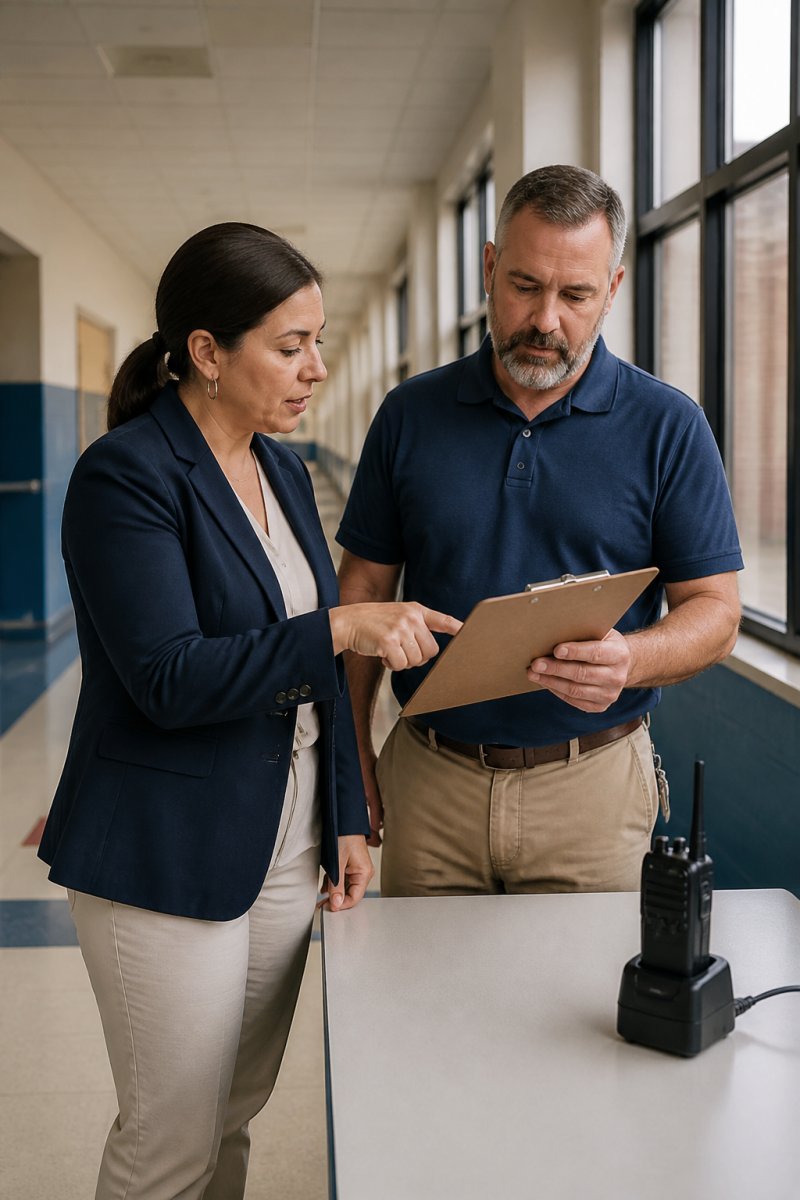
Staff training builds the skills; tabletop exercises test them under pressure. Run a tabletop exercise once per term, and keep it to 90 minutes.
A simple format that works:
- Pick one scenario, such as a week-long power outage or a data breach.
- Walk through the first 24 hours, hour by hour.
- Ask each lead what they would do and what they need.
- Record every gap the discussion exposes.
- Assign one owner and one deadline per gap.
The UK Cabinet Office resilience guidance recommends testing plans against reasonable worst-case scenarios rather than best-case assumptions. For schools, that means planning for the disruption that would hurt most, not the one that is easiest to imagine.
Step 4: Create a School Crisis Management Plan
A school crisis management plan is the short, action-focused document your team uses during the first hours of a serious incident. It differs from continuity planning: continuity keeps services running over weeks, while crisis management handles the immediate response.
Your crisis plan needs four things:
- A named incident lead and two deputies
- A single communication channel for staff
- Pre-written message templates for parents and staff
- A decision log so you can review choices later
Keep it to two pages. The longer it gets, the less likely anyone reads it under pressure.
Incident Response and Communication Protocols
Incident response works best as a fixed sequence. Follow the same order every time so nothing gets missed.
- Assess - confirm what happened and who is at risk
- Activate - call the incident lead and open the log
- Communicate - send the first holding message within 30 minutes
- Control - contain the damage and protect people first
- Recover - restart essential services in priority order
- Review - debrief within five working days
Communication is where most schools struggle. Parents forgive delays when they hear something clear and honest. They do not forgive silence. Write your first-holding-message template in advance, with blanks for the facts you will not know until the moment.
Budget-Friendly Resilience Strategies for Public Schools
Resilience does not require a big capital budget. Most of the highest-value steps cost staff time, not money. This is the gap most corporate resilience guides ignore, and it is the one that matters most for public schools.
Low-cost moves that deliver real protection:
- Cross-train staff so more than one person can run payroll, order supplies, or manage the building systems
- Agree mutual aid with nearby schools to share kitchens, halls, or transport in an emergency
- Digitise your paper records and store a copy off site
- Service equipment on schedule because breakdowns are cheaper to prevent than to fix
- Track your asset condition so you can argue for budget with evidence, not anecdotes
The Department for Education guidance on school resource management encourages schools to use condition data to prioritise spending. A simple facility condition assessment gives your board the evidence it needs to release funds for the repairs that prevent closures.
Where Campus Pro helps most is here: our free role-based FM audits give you an FM Health Score in about three minutes, so you can see exactly which gaps to fix first before you spend anything.
School-Specific Digital Infrastructure Resilience and Mental Health Integration
Two areas separate a school resilience plan from a generic business one: digital systems that hold student data, and the mental health of the people who respond to crises. Most frameworks cover neither well.
On the digital side, schools now depend on networks, cloud platforms, and connected building systems. Plan for:
- Offline access to safeguarding and contact records
- Tested backups, stored separately from your main network
- A cyber incident playbook, not just an IT policy
- Clear rules on who can restore systems and how fast
On the human side, disruption affects staff and students long after the building reopens. Build in:
- A named wellbeing lead for the response team
- Rotas so the same people are not on call every time
- Debriefs that include emotional impact, not just logistics
- Signposting to support for students after a traumatic event
The UK government guidance on emergency planning in schools treats pupil and staff wellbeing as part of the response, not an afterthought. Schools that pair digital recovery with human recovery reopen faster and recover trust sooner.
Conclusion: Building Adaptive Capacity for Long-Term Stability
The schools that cope best with disruption are not the ones with the thickest plans. They are the ones that review, test, and adjust every term. That habit is what builds adaptive capacity, and it is what keeps essential services running when the unexpected arrives.
If your team is stretched too thin to build this alone, Campus Pro provides executive-level facilities and operations leadership on a fractional basis.
Get started with Campus Pro and build a resilience plan your team can actually use.
Frequently Asked Questions
What are the 5 pillars of operational resilience?
The five pillars are business continuity, risk management, incident response, dependency mapping, and governance. For schools, these translate to keeping essential services running, assessing threats, responding to crises, understanding what relies on what, and having clear oversight. A school that masters these pillars can maintain learning even when disruptions hit. Start by mapping your critical systems, then build plans around each pillar.
How often should schools review and test their continuity plans?
Schools should review continuity plans at least annually and after any significant disruption. Testing through tabletop exercises twice a year keeps staff sharp. After each test, update the plan based on what you learned. A plan that sits on a shelf collects dust; one that gets exercised builds real adaptive capacity. Assign a coordinator to track review dates and document changes so nothing slips through.
How can schools maintain learning during an emergency?
Maintaining learning during an emergency requires pre-built digital infrastructure and clear communication channels. Schools should have a learning management system ready, devices available for students without home access, and a parent notification system tested regularly. Define impact tolerances for instruction: how many days can learning pause before it harms students? Then build contingency plans, such as asynchronous lessons or alternate sites, that kick in before that threshold is crossed.
What should a school operational resilience plan include?
A complete plan includes a risk assessment, dependency map, impact tolerances, incident response procedures, staff training schedules, and communication protocols. It should name who does what during a disruption and how you will recover essential services. Include budget-friendly strategies like shared resources and cross-training staff. Review the plan annually and after any real event. The goal is not a perfect document but a living framework your team can execute under pressure.